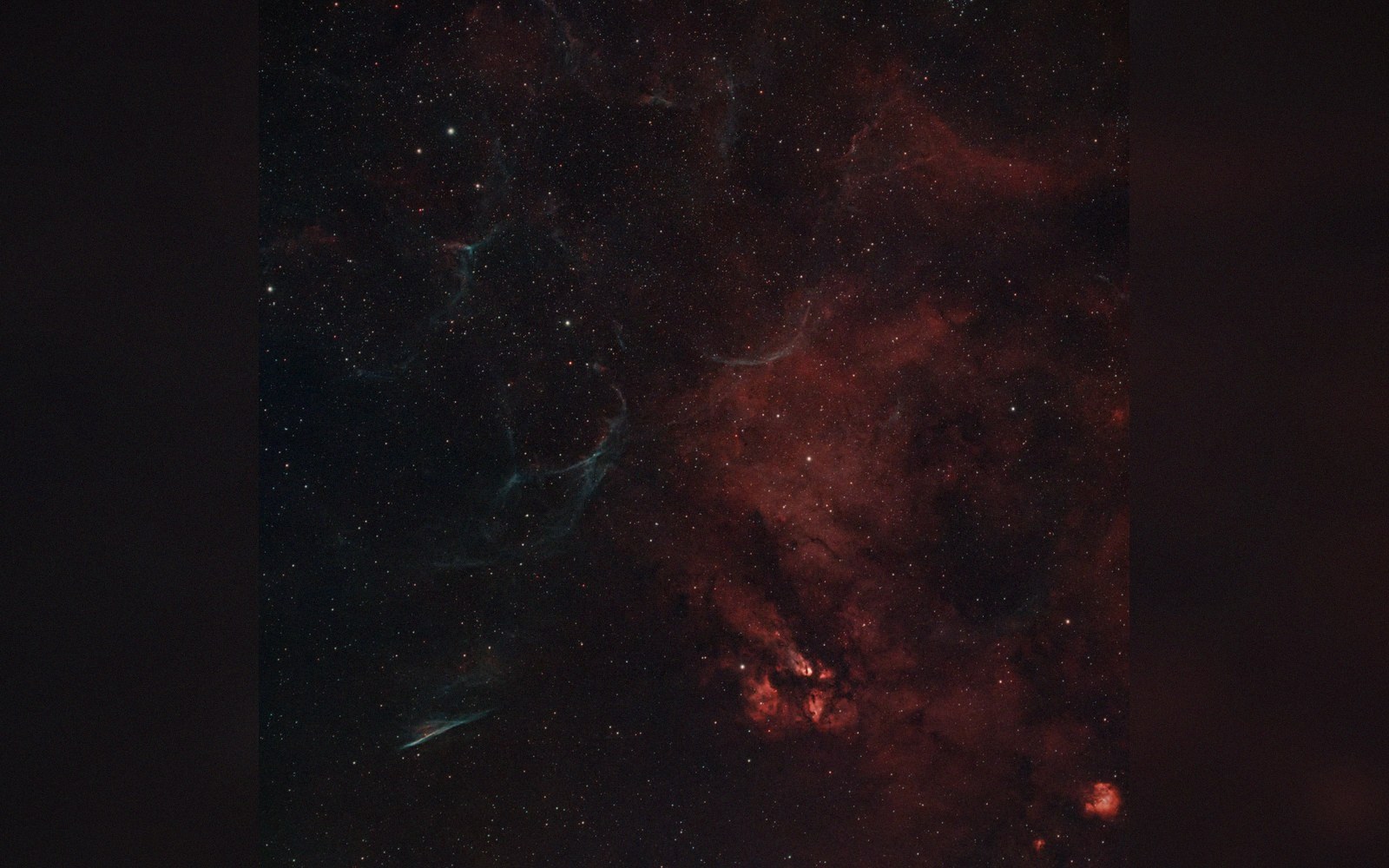
The objects defined by absence — cold dust blocking the stars behind.
Photo: Dennis Ariel / Pexels
Where the stars stop

A dark nebula is not empty. It is a dense cloud of cold dust and molecular gas — optically thick enough to absorb or scatter nearly all the light coming from behind it. You see it not because it glows but because the star field simply stops. The background drops out, and something shapeless and lightless sits in the hole.
The nearest and most dramatic examples are already familiar to most observers, even if they have never thought of them as distinct objects. The Coal Sack, visible from southern latitudes, is a ragged patch of near-total darkness pressed against the Milky Way's brightest run of stars in Crux. At northern declinations, the dark lanes threading the Milky Way through Cygnus and Ophiuchus are the same phenomenon on a vast scale — not gaps in the stellar distribution, but curtains of intervening cloud.
Edward Barnard systematically catalogued these objects in the early twentieth century, photographing the Milky Way and noting every lane, globule and opacity he could identify. The Barnard Catalogue, published in final form in 1927, lists 349 objects. Many have since become standard targets in their own right: B33, the Horsehead Nebula in Orion, is probably the most observed dark nebula in the sky, though it is genuinely hard at the eyepiece — the emission nebula IC 434 behind it is the only reason the silhouette registers at all.
The nearest and most dramatic examples are already familiar to most observers, even if they have never thought of them as distinct objects.

At the extreme end sit Bok globules, named for astronomer Bart Bok, who drew attention to them in the 1940s: small, nearly circular dark patches, often only a few arcminutes across, sometimes embedded in emission nebulae. They are collapsing proto-stellar cores, and several have been confirmed to contain young stars not yet visible in ordinary light.
Through glass on a good night, the experienced eye learns to read absence: a region where the star counts thin, where the background fades toward nothing, where the Milky Way's texture breaks and goes smooth. There is nothing on the retina to hold — only the growing certainty that something large and cold is standing between you and the rest of the galaxy.