A dying star lit from inside
A shell of shed atmosphere, a naked stellar core, and a name that has nothing to do with planets.
A planetary nebula is a shell of shed atmosphere fluorescing under the naked core. The name is a mistake nobody corrected.
The wrong word that stuck

William Herschel coined the term "planetary nebula" in the 1780s because some of these objects showed a round, greenish disc in his telescope — superficially similar, he thought, to the planet Uranus. He was wrong about what they were, and he knew the comparison was imperfect, but the name lodged in the literature and nobody has seriously tried to dislodge it since. A planetary nebula has no relationship to planets whatsoever.
What Herschel was actually seeing was a star in the process of dying — not violently, but gradually, like a slow exhalation. When a mid-mass star like the Sun exhausts the hydrogen fuel in its core, it swells into a red giant, then an asymptotic giant branch star, pulsing and shedding its outer layers over tens of thousands of years. Those expelled shells of gas drift outward into surrounding space. What remains at the centre is the exposed core: a white dwarf, extremely hot, radiating intensely in the ultraviolet.
A shell that lights itself

That ultraviolet flood is the engine. The white dwarf bombards the surrounding gas — mostly hydrogen and helium, laced with heavier elements the star cooked up during its lifetime — with photons energetic enough to strip electrons from atoms. When those electrons recombine, they drop back to lower energy levels and emit light at specific wavelengths. Doubly ionised oxygen emits strongly at 495.9 and 500.7 nanometres, producing the greenish glow that fooled Herschel. Hydrogen emits in red. The shell is not reflecting the star's light; it is converting it, re-radiating it at wavelengths the eye can actually detect.
The white dwarf bombards the surrounding gas — mostly hydrogen and helium, laced with heavier elements the star cooked up during its lifetime — with photons energetic enough to strip electrons from atoms.
This is the same process at work in emission nebulae, where hot young stars ionise surrounding gas clouds. The physics is identical; only the origin differs. An emission nebula is a stellar nursery lit by newborns. A planetary nebula is a stellar coffin lit by a cooling corpse.
In a small telescope, a bright planetary looks distinctly different from a star — it holds a disc, however tiny, and it does not sharpen with magnification the way a stellar point does. In a larger instrument you may see structure: concentric rings, bipolar lobes, a brighter inner shell. The Ring Nebula in Lyra, catalogued as M57, is the textbook case: a smoke ring suspended in space, with the white dwarf visible at the centre to observers with sufficient aperture and dark sky. The Dumbbell Nebula, M27 in Vulpecula, is larger and brighter, visually softer, shaped more like an apple core than a ring because we see it at an oblique angle to the ejection axis.
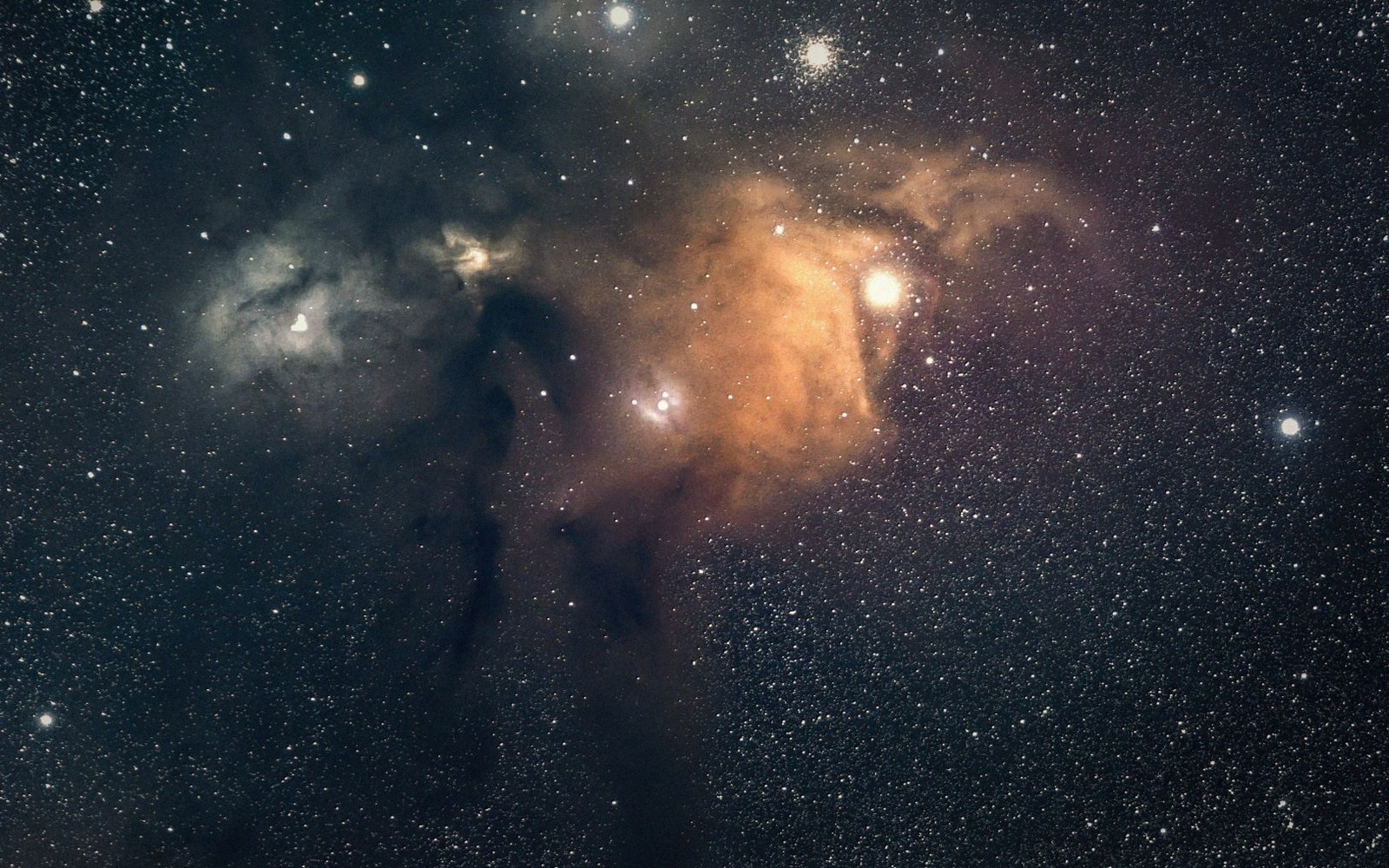
The visible structure is rarely a simple sphere. Stellar magnetic fields, rotation, and companion stars all skew the outflow into lobes, jets, and ripples. Some planetaries look like eyes; some like hourglasses; some like delicate nested bubbles. The physical lifetime of a typical planetary nebula is short by astronomical standards — on the order of twenty to fifty thousand years before the gas disperses into the interstellar medium and becomes invisible. The white dwarf persists for billions of years beyond that, cooling imperceptibly.
There are several thousand known in the Milky Way. Most are faint and small, requiring a nebula filter to separate from the background sky. A handful are showpieces even in modest aperture. All of them share the same biography: a common star, not so different from the Sun, that spent its fuel, breathed out its skin, and left a glowing reminder of itself hanging in the dark — misnamed by a man who nevertheless found it beautiful enough to describe.