Emission and reflection
Two kinds of bright nebula look much the same in a finder chart. They are lit by entirely different physics.
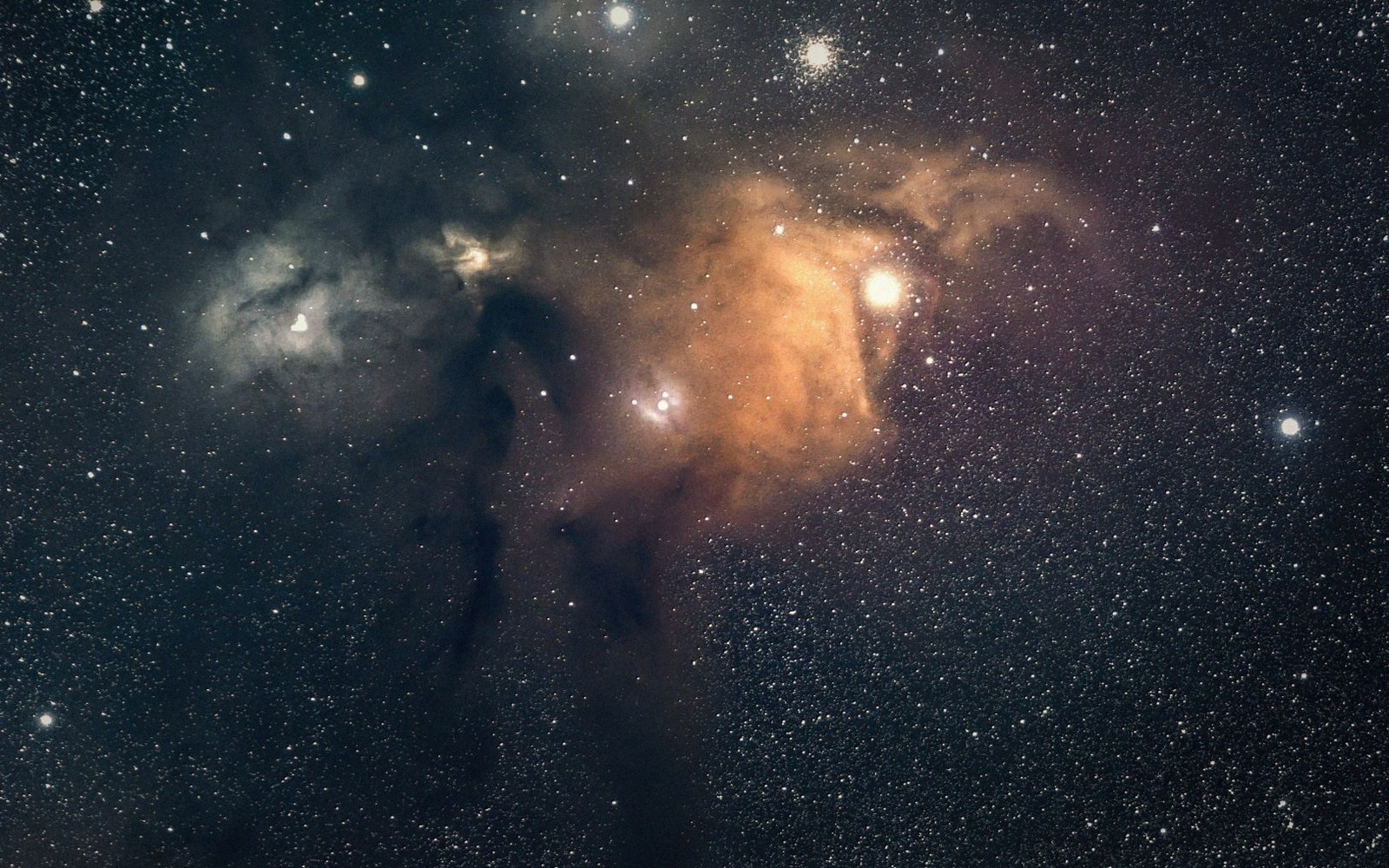
Gas that glows, and dust that only borrows light.
Photo: Dennis Ariel / Pexels
What you are actually seeing
Photo: Colon Freld / Pexels
A cloud of interstellar gas near a hot enough star does something gas clouds rarely do: it glows under its own power. The star's ultraviolet radiation strips electrons from hydrogen atoms; when those electrons fall back to lower energy levels, they release light at specific wavelengths. That characteristic red of hydrogen-alpha, that blue-green of doubly ionised oxygen — these are not reflected starlight. The nebula is a light source in its own right. We call this fluorescence, and the nebulae that do it are emission nebulae.
Dust clouds behave differently. Interstellar dust grains scatter starlight rather than converting it, and they scatter blue wavelengths most efficiently — which is why reflection nebulae are almost always bluish, and why their central star tends to be of a spectral type just slightly too cool to ionise the surrounding gas. The Pleiades are surrounded by exactly this kind of cloud: the gauzy wisps around the cluster's stars borrow their light and give nothing back of their own making.
The dividing line is the surface temperature of the illuminating star. Roughly speaking, a star hot enough to flood its surroundings with ionising ultraviolet produces an emission nebula; a cooler star produces a reflection nebula, or nothing visible at all. Some regions contain both — the Orion Nebula, M42, shows primarily emission but includes reflection components near its brightest stars.
Roughly speaking, a star hot enough to flood its surroundings with ionising ultraviolet produces an emission nebula; a cooler star produces a reflection nebula, or nothing visible at all.
Through the eyepiece
At the eyepiece the distinction matters practically. Emission nebulae respond dramatically to a narrowband or O-III filter, which passes only the specific wavelengths the glowing gas emits while blocking most of the sky background — the contrast gain can be extraordinary. Reflection nebulae do not respond to those filters at all: because they are shining with broadband scattered starlight, cutting most of the spectrum cuts most of the object too. A filter that transforms an emission nebula into something unmistakable will make a reflection nebula disappear.
Visually, emission nebulae often show more structure — lanes of extinction, bright knots where density peaks. Reflection nebulae tend to look softer, their edges less defined, fading into the background without a clear boundary. Neither glows in any colour the dark-adapted eye can reliably register; both appear as grey-white luminosity. The physics that separates them is invisible to the unaided retina. It shows up in the filter's behaviour, in the spectroscope, and in photographs that have the time to collect the wavelengths no human eye ever accumulates.