A hundred thousand stars in a ball
They predate the spiral arms. They orbit above and below the disc like a swarm of ancient sentinels, and a small telescope will show you the oldest light you can see with your own eye.

Globulars are older than the galaxy's disc and orbit it as a halo. Through glass they resolve at the edges before the middle.
What you are actually looking at

Photo: Beyza Kaplan / Pexels
A globular cluster is a gravitationally bound sphere of stars — tens of thousands of them in a modest example, a million or more in an extreme one. Unlike the loose, young families of open clusters, a globular holds itself together across cosmic time. The mutual gravity of so many stars packed into a volume perhaps a hundred light-years across is enough to resist the slow tidal shredding of the galaxy for billions of years. Most globulars are between ten and thirteen billion years old, which means they formed before the Milky Way had finished assembling itself. They do not live in the disc; they orbit the galactic centre in a vast spherical halo, plunging through the plane on long elliptical paths and emerging the other side. They are relics of the galaxy's earliest epoch, still circling.
Because they formed so early, their stars had almost no heavy elements to work with — astronomers describe this as low metallicity, meaning a composition close to the primordial hydrogen and helium of the young universe. The stars that survived to the present in a globular are predominantly old red giants and their cooler, dimmer relatives. Hot blue stragglers exist too, thought to be stars that merged or were re-energised by close encounters in the packed core, but the dominant population is ancient and red. The colour is real; the eye rarely gets any of it at low light levels, so visually a globular reads as grey.

Through the eyepiece
Point a small telescope at a bright globular and the first impression is a soft, condensed glow — brighter toward the centre, fading at the edges without a clear boundary. Increase magnification and something changes at the periphery: the outermost stars begin to resolve into points, a granular texture spreading inward. The core often resists much longer. This is not an optical trick; it reflects real structure. Stars in a globular are not evenly distributed — they concentrate toward the centre under the pull of core collapse dynamics, packing so densely that even a large aperture cannot split them cleanly. The edge resolves first because there the stars are genuinely more spread out.
Point a small telescope at a bright globular and the first impression is a soft, condensed glow — brighter toward the centre, fading at the edges without a clear boundary.
What resolving the edge requires is aperture and a dark, steady sky. Under good conditions, even a 75 mm refractor will grain the outer halo of Omega Centauri or M13 into individual sparks. At 150 mm the resolution creeps noticeably inward. A 300 mm instrument on a transparent night makes a bright globular look almost three-dimensional — a dense core surrounded by a spray of stars that seems to float in front of a fainter background field.
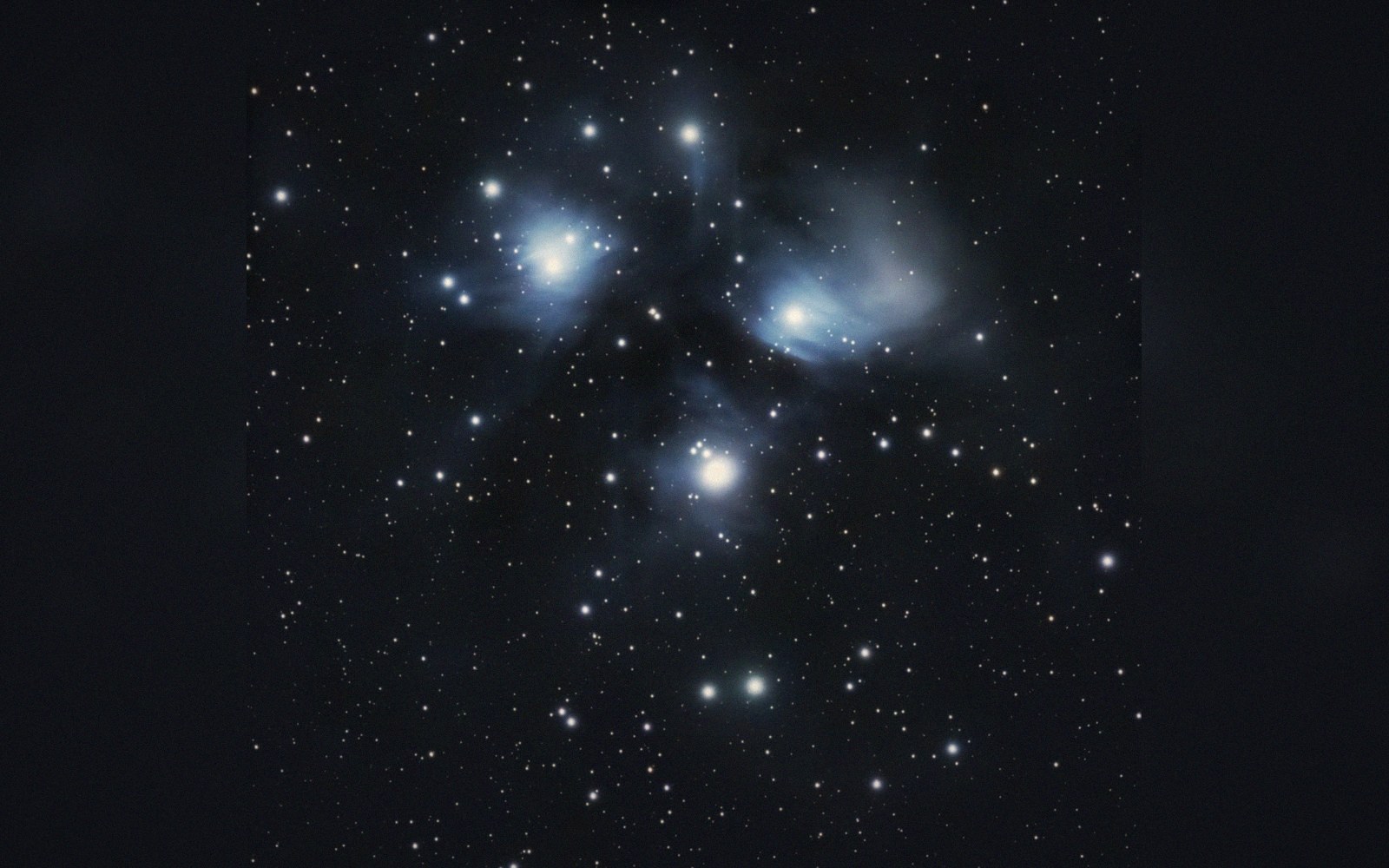
The best globulars visible from mid-northern latitudes include M13 in Hercules, M5 in Serpens and M15 in Pegasus, each a distinct character: M13 sprawling and rich, M5 arguably tighter and more symmetrical, M15 harbouring one of the densest cores known. From southern latitudes, Omega Centauri and 47 Tucanae stand apart from every other object in this class — each so large and bright that they were catalogued as stars before anyone understood what they were.
The Milky Way keeps roughly 150 known globular clusters in its halo, though the true number is probably higher, obscured behind the dust of the galactic plane. Other large galaxies have their own retinues — some ellipticals carry thousands. But that abstraction collapses the moment you push a small telescope into focus on one and watch a hundred thousand ancient suns resolve, one by one, from the outside in.