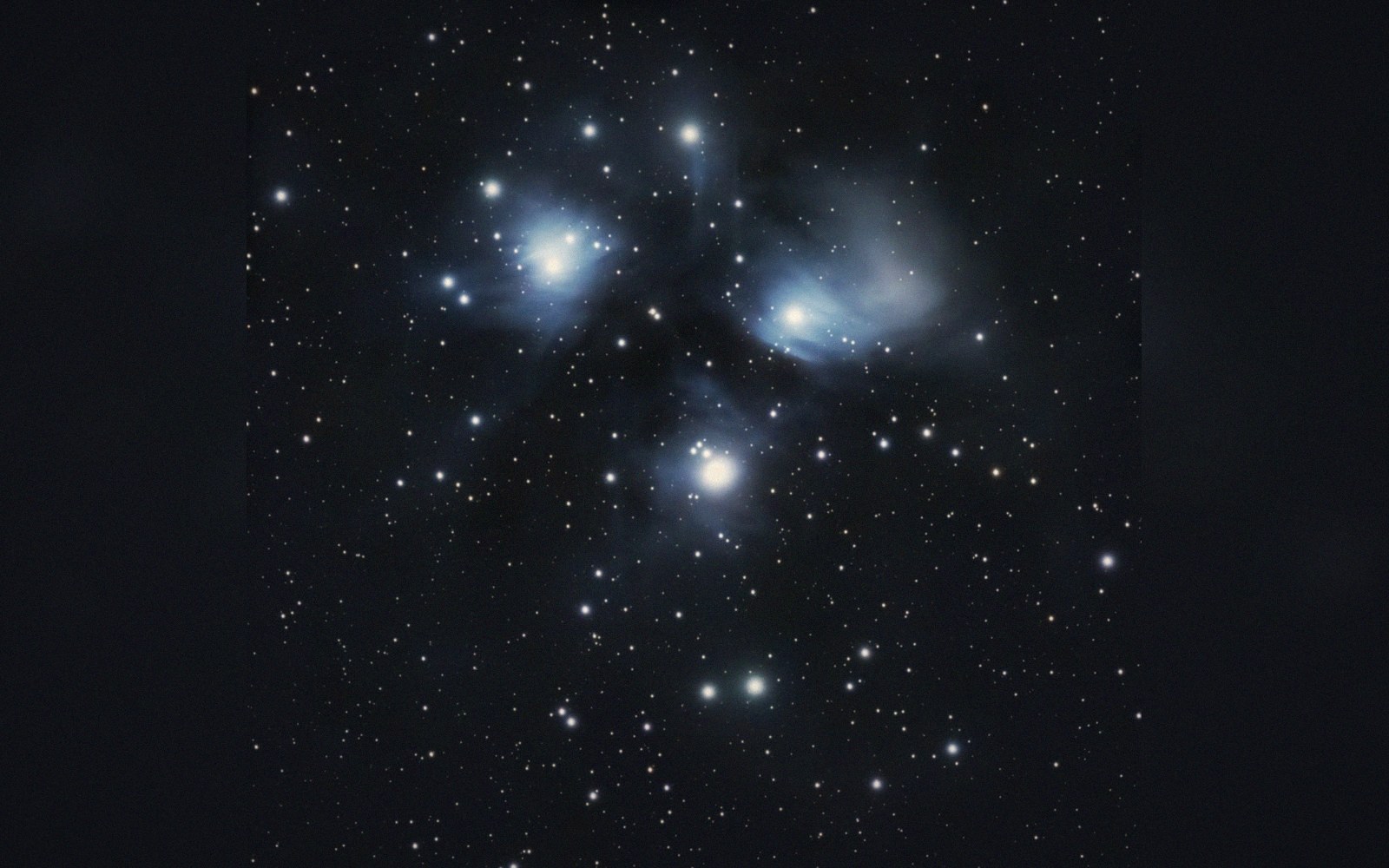
Young, loose, and dispersing — a family that will not stay together.
Photo: ArWeltAtty Attila / Pexels
An open cluster is a stellar nursery caught in the act of going its separate ways. Hundreds or thousands of stars born from the same collapsing cloud of gas and dust, sharing a common origin, a common age, and — for a while — a common address. The key word is for a while. Unlike the gravitationally locked balls of a hundred thousand stars that orbit the galaxy's halo for billions of years, open clusters are fragile things. Differential galactic rotation, the tidal pull of passing molecular clouds, and the simple scatter of stellar velocities all work to pull them apart. Most dissolve within a few hundred million years. The Sun itself probably formed in one, and has long since drifted away from its birth siblings.

What they look like through glass
Through any telescope, an open cluster is one of the most immediately satisfying sights in the sky — stars resolved cleanly against the background, often with a sense of real depth, and sometimes with striking colour contrasts between hotter blue-white members and cooler stragglers. The Pleiades and the Hyades are naked-eye examples; the former is barely 100 million years old, its hot blue stars still burning bright. The Beehive Cluster in Cancer and the Double Cluster in Perseus are perennial targets, each different in character: the Beehive loose and sprawling, the Double Cluster paired and dramatic even in binoculars.
The Pleiades and the Hyades are naked-eye examples; the former is barely 100 million years old, its hot blue stars still burning bright.
What you are reading in any open cluster is age. Young clusters blaze with blue supergiants; old ones have lost their most massive stars to early deaths and show a population turned orange and yellow. The point on the cluster's HR diagram where stars begin to leave the main sequence — the turnoff point — is a direct clock. Astronomers use it routinely; visual observers can get a feel for it just by colour.
Catalogues are full of them. Messier logged the most obvious ones; the NGC expanded the list into the hundreds. Some entries in both catalogues turn out, on inspection, to be loose, poorly-defined gatherings that barely qualify — the boundary between a true cluster and a chance alignment of unrelated field stars is genuinely fuzzy, and not everyone agrees on where to draw it.