The colour nobody sees
Cluster stars have real colours. The eye at the eyepiece almost never gets them.
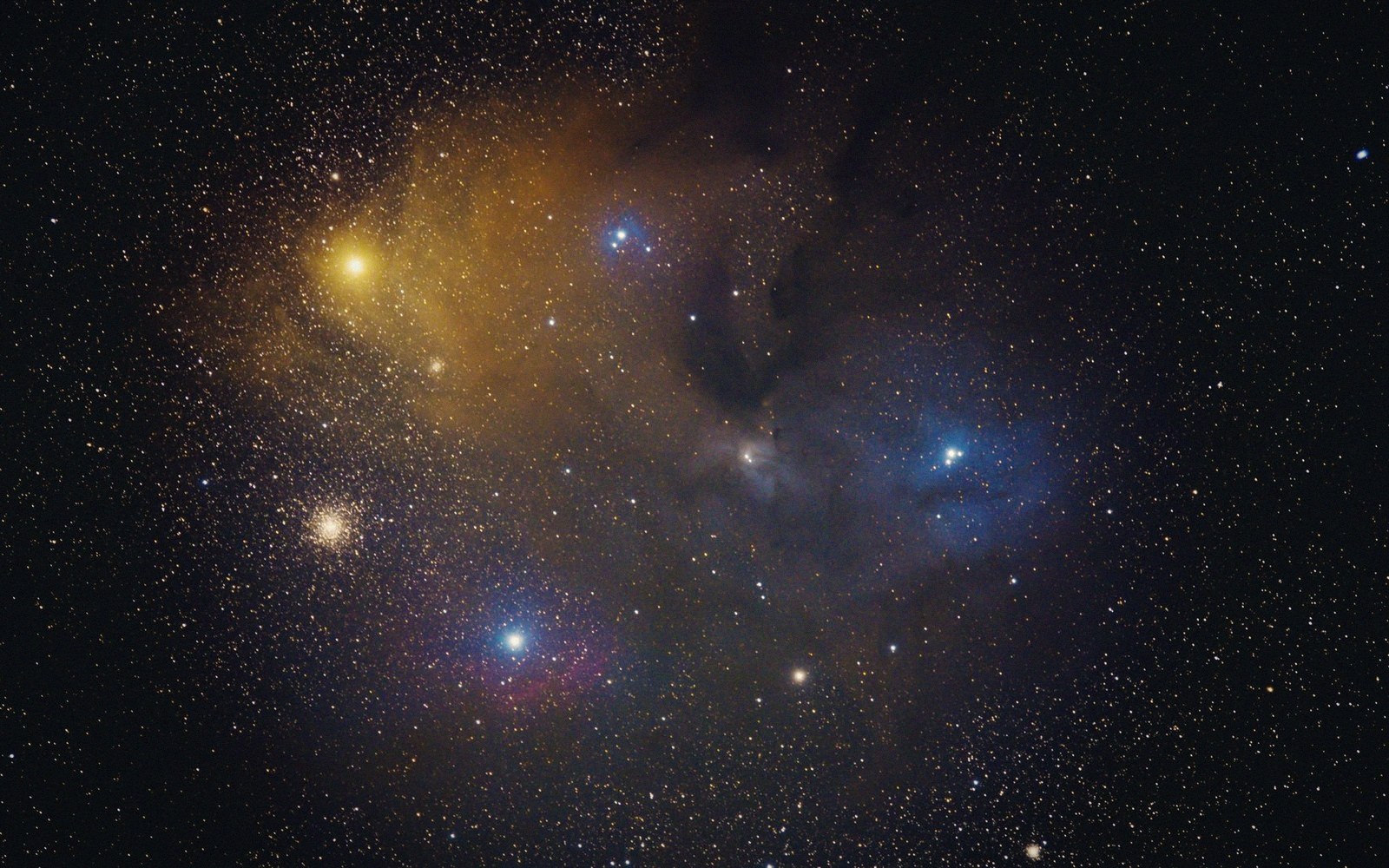
Cluster stars have real colours; the eye rarely gets any of them.
Photo: Damien Leyden / Pexels
What the stars are actually doing
Photograph an open cluster — the Pleiades, say, or the Jewel Box in Crux — and the colours announce themselves immediately. Sapphire-hot B-type stars jostle with yellow giants; an occasional red supergiant bleeds rust into the frame. The light is genuinely there. The colours are not a camera's invention.
At the eyepiece, almost all of it goes away.
The reason is physiological and blunt. Human vision runs on two receptor systems: cones, which register colour but need reasonable light levels to fire properly, and rods, which are exquisitely sensitive to dim light but carry no colour information at all. Dark adaptation shifts the eye progressively toward rod dominance, which is exactly what you want for faint objects — and exactly what kills colour perception. The fainter the source, the more the rods take over, and the more the world drains toward grey.
Photo: Beyza Kaplan / Pexels
A single star bright enough to land on a cone-rich part of the retina will show colour. Arcturus looks orange to most observers; Vega looks noticeably blue-white. But in a cluster, even a bright one, most members are too faint individually to cross the cone-activation threshold. The eye accumulates the light without registering its wavelength. You see the star, but not what colour it is.
What does come through
A single star bright enough to land on a cone-rich part of the retina will show colour.
A few things survive. Red stars often hold their hue longest into dimness; the eye's red-sensitive cones have a slightly lower threshold than the others, which is why experienced observers sometimes catch a warm tint on a cluster's brightest giants that disappears the moment you look away from it. Averted vision — the trick of looking slightly off-target to engage more rod-dense retina — retrieves the star's presence but loses the colour entirely. You cannot win both at once.
Contrast between two adjacent bright stars can be read, if both are above threshold: a blue-white pairing next to a yellow one may register as different, if not richly coloured. Very red carbon stars, which concentrate their output narrowly in wavelengths the eye's red cones handle best, are the most reliably coloured objects a cluster can offer.
Everything else — the colour-temperature gradient across the cluster's stellar population, the cool orange giants, the whole photogenic spread that makes astrophotography so satisfying — is information the eye collects and silently discards.
The photograph is not lying. The telescope is not broken. The gap between image and eyepiece experience is simply the gap between a detector with no threshold and one that evolved for something other than stellar spectroscopy.